Showing posts with label Enda Kenny. Show all posts
Thursday, 24 October 2013
It's the right thing to do, because it's about the children
Dear God, who will rid us of this troublesome Taoiseach?
I was listening to the Great Unbearable on the radio this morning as he was asked to comment on the abduction of two innocent Roma children by Irish State authorities on the dubious premise that they had blonde hair.
"This is about children, it's about children."
Oh, so that's okay then. This is one of those lines that politicians run to when all else fails, and when Enda is being interviewed in public you can rest assured that all else has already failed. Other fall back lines are: "It's the right thing to do" and "This is about protecting lives", usually before you're whacked with a Mickey Finn.
So it's about children.
Presumably when children were taken off unwed mothers and put up for adoption in foreign countries it was about children.
Presumably when children were sent to industrial schools because their parents were poor or their mother had died it was about children.
Now of course we're told we must wait while An Garda Siochana and the HSE investigate themselves before we form any conclusions or comment.
It might have been helpful if the same Guards and HSE had waited, investigate and formed some conclusions before snatching the children in the first place.
Let's have a look at Section 12 of the Child Care Act, 1991, the legal provision used by the Guards.
12.—(1) Where a member of the Garda Síochána has reasonable grounds for believing that—
(a) there is an immediate and serious risk to the health or welfare of a child, and
(b) it would not be sufficient for the protection of the child from such immediate and serious risk to await the making of an application for an emergency care order by a health board under section 13,
the member, accompanied by such other persons as may be necessary, may, without warrant, enter (if need be by force) any house or other place (including any building or part of a building, tent, caravan or other temporary or moveable structure, vehicle, vessel, aircraft or hovercraft) and remove the child to safety.
An "immediate and serious risk". Being blonde carries some risks - but I'm not sure sufficient to warrant [Ed: they don't need a warrant] police action.
Remember during the referendum on children the No side warned about State overreach and intrusion into the family.
And you're not even safe in a hover craft. Perhaps a hot air balloon.
Wednesday, 25 September 2013
Mother of Mercy - Mater Hospital joins the league of abrortionists
"By caring for the sick in the Mater Misericordiae University Hospital we participate in the healing ministry of Jesus Christ; we honour the spirit of Catherine Mc Auley and the Sisters of Mercy; we pledge ourselves to respect the dignity of human life; to care for the sick with compassion and professionalism; to promote excellence and equity, quality and accountability."
This is Mission Statement of the Mater Hospital in Dublin which has just announced it will be carrying out abortions under Kenny's Law.
Even the Irish Times managed to see the inconsistency trumpeting:
"The Mater Misericordiae University Hospital is a Catholic voluntary hospital and was founded by the Sisters of Mercy in 1861. In its mission statement, the hospital says that by caring for the sick, “we participate in the healing ministry of Jesus Christ”.
The Irish Times also notes that:
"The Mater hospital is a single-member company.
Its website says the majority of the members of the parent company are Sisters of Mercy and the remaining members represent the Catholic Archdiocese of Dublin, the Catholic Nurses’ Guild of Ireland, the Society of St Vincent de Paul and the medical consultants of Mater Misericordiae University Hospital and the Children’s University Hospital."Fr Kevin Doran has said "no comment". I presume this will be another case of the Grand Old Duke of York, up the hill and down again. Just as Archbishop Eamon Martin huffed and puffed and threatened excommunication before the legislation was passed before retreating afterwards and refusing to implement Canons 915 and 916 which require that pro-abortion politicians be refused Holy Communion.
Fr Doran took a similar postion on RTE's Would You Believe the other night in a dreadful performance, confused, stammering, unclear. While the "silenced" Tony Flannery pontificated away, attacking the Vatican.
So, if you have the energy for it you can contact the Mater Hospital to complain. Use the contact form here. I left a sarky message saying I presumed they'd be changing the Mission Statement and name of the hospital.
You can also write, email or phone the Board of Governors. The Secretariat and Registered Office for MMCUH is at 74 Upper Dorset Street, Dublin 1.
Telephone: 018607083
E-mail: sryan@mmcuh.ie
It would also be worth emailing the Sisters of Mercy - mercy@csm.ie since their fingerprints are all over this.
Tuesday, 18 June 2013
Enda Kenny, Schrödinger's Catholic
So now we know the true inspiration for the beloved leader; Enda Kenny is modelling himself on Schrödinger's cat. He is simultaneously a Catholic and a non-Catholic, in fact the first non-Catholic Taoiseach. Presumably since he's not a "male Taoiseach", but a Taoiseach who happens to be a male he's also the first non-male Taoiseach. I wonder what toilets he uses in Leinster House.
Terence O'Neill, the last proper Prime Minister of Northern Ireland, once said, "Our faith is meant to enrich our lives - too often our lives impoverish our faith".
St Paul said, in the Mass readings on Saturday: "We are ambassadors for Christ".
C.S. Lewis said: "Where the tide flows towards increasing State control, Christianity, with its claims in one way personal and in the other way ecumenical and both ways antithetical to omnicompetent government, must always in fact ( though not for a long time yet in words) be treated as an enemy. Like learning, like the family, like any ancient and liberal profession, like the common law, it gives the individual a standing ground against the State.”
Epistle to Diognetus (2nd/3rd Century): "the Christian is to the world what the soul is to the body".
Lumen Gentium (Ch. 4): "Because of the very economy of salvation the faithful should learn how to distinguish carefully between those rights and duties which are theirs as members of the Church, and those which they have as members of human society. Let them strive to reconcile the two, remembering that in every temporal affair they must be guided by a Christian conscience, since even in secular business there is no human activity which can be withdrawn from God's dominion....Each individual layman must stand before the world as a witness to the resurrection and life of the Lord Jesus and a symbol of the living God."
Enda Kenny: "I'm a Catholic when it's convenient and non-Catholic when it counts".
Terence O'Neill, the last proper Prime Minister of Northern Ireland, once said, "Our faith is meant to enrich our lives - too often our lives impoverish our faith".
St Paul said, in the Mass readings on Saturday: "We are ambassadors for Christ".
C.S. Lewis said: "Where the tide flows towards increasing State control, Christianity, with its claims in one way personal and in the other way ecumenical and both ways antithetical to omnicompetent government, must always in fact ( though not for a long time yet in words) be treated as an enemy. Like learning, like the family, like any ancient and liberal profession, like the common law, it gives the individual a standing ground against the State.”
Epistle to Diognetus (2nd/3rd Century): "the Christian is to the world what the soul is to the body".
Lumen Gentium (Ch. 4): "Because of the very economy of salvation the faithful should learn how to distinguish carefully between those rights and duties which are theirs as members of the Church, and those which they have as members of human society. Let them strive to reconcile the two, remembering that in every temporal affair they must be guided by a Christian conscience, since even in secular business there is no human activity which can be withdrawn from God's dominion....Each individual layman must stand before the world as a witness to the resurrection and life of the Lord Jesus and a symbol of the living God."
Enda Kenny: "I'm a Catholic when it's convenient and non-Catholic when it counts".
Friday, 14 June 2013
Friday, 31 May 2013
The Kenny-Martin catechetical failure
Mssrs Kenny and Martin, Taoiseach and Leader of the Opposition are fine examples of what is wrong with the faith in Ireland and with religious formation over the last number of years.
I don't want to repeat their banalities, nor to trouble myself with finding their specific comments in response to statements made by Irish bishops or a Monsignor from the Vatican. But there are three key things they appear not to undertand:
1. Ecclesiology. They declare themselves to be Catholics but give no indication that they understand what that means. When they refer to "The Church" it is always in reference to something else, something external to them. It is an NGO, a lobby, a pressure group. We are constantly being told by liberal Catholics about the bad old days before Vatican II when ordinary Catholics thought the Church meant "the bishops". Well, I don't buy that. If you read remarks from politicians of old it is obvious they had a far clearer notion of their place within the Church than people do today.
2. Conscience. This means only doing what you want. Unless The Party decides otherwise. The generation of Catholics who took their lead from Professor Paddy Hannon and the Irish Episcopal Conference. When asked to discuss the real issue they fall back on platitudes of "complex" and "sensitive", "divisive" and "divergent". And yet still try to impose your own view without a free vote.
3. Morality. If something is wrong in itself then it can't be made right by legislation, or by doctors or psychiatrists or the ECHR. And if it is wrong in respect of even one child, then it is irrelevant if it opens the floodgates or not. If a bad law allows the direct, intentional, killing of only one child in a century, it remains a bad law. In this past week we have seen the heroic efforts to rescue a new born baby from a sewage pipe, in the same country that would have had no problem killing her before birth. Wales saw the biggest search in its history last year to find one lost child, April Jones. We value every child, whether conceived in rape or incest, whether a genius or a genetic failure.
I don't want to repeat their banalities, nor to trouble myself with finding their specific comments in response to statements made by Irish bishops or a Monsignor from the Vatican. But there are three key things they appear not to undertand:
1. Ecclesiology. They declare themselves to be Catholics but give no indication that they understand what that means. When they refer to "The Church" it is always in reference to something else, something external to them. It is an NGO, a lobby, a pressure group. We are constantly being told by liberal Catholics about the bad old days before Vatican II when ordinary Catholics thought the Church meant "the bishops". Well, I don't buy that. If you read remarks from politicians of old it is obvious they had a far clearer notion of their place within the Church than people do today.
2. Conscience. This means only doing what you want. Unless The Party decides otherwise. The generation of Catholics who took their lead from Professor Paddy Hannon and the Irish Episcopal Conference. When asked to discuss the real issue they fall back on platitudes of "complex" and "sensitive", "divisive" and "divergent". And yet still try to impose your own view without a free vote.
3. Morality. If something is wrong in itself then it can't be made right by legislation, or by doctors or psychiatrists or the ECHR. And if it is wrong in respect of even one child, then it is irrelevant if it opens the floodgates or not. If a bad law allows the direct, intentional, killing of only one child in a century, it remains a bad law. In this past week we have seen the heroic efforts to rescue a new born baby from a sewage pipe, in the same country that would have had no problem killing her before birth. Wales saw the biggest search in its history last year to find one lost child, April Jones. We value every child, whether conceived in rape or incest, whether a genius or a genetic failure.
Tuesday, 28 May 2013
Lest we forget - the dawn of a new, well, everything
Ah, it's easy to forget the bright hope that shone upon our land just two years ago before it all sank under the lies and broken promises, that first Dáil speech:
"It is said that the tomorrow imprinted on our ancestral retina is our today. So, when our children look into our eyes, I want them to see a future where kindness, goodness, dreams and imaginings, strength and belief passed silently and unobtrusively from mother to daughter and father to son over the millennia, merge to create a life of authenticity, honesty, dignity, compassion, brilliance, creativity, purpose, confidence, generosity, affection, laughter and heart, a life where they can plan, hope, dream and live their dreams in their own country. [Unless their mother says she's suicidal, in which case, pity about you]
That our lives and futures are predicated on one thing is true. That is why today I enter into a covenant with the Irish people. In these times of crisis, full of many unknowns, honesty is not alone our best policy but our only policy. The new Government will tell the people the truth regardless of how unwelcome or difficult that might be. We will tell it constantly and unreservedly. It is the only way because the people always have a right to know. I use the word “covenant” over “pledge” and “promise” because I believe the old ways of politics damaged us not alone financially, but emotionally, psychologically and spiritually. The word “covenant” restores a sense of heart, soul and spirit to leadership and our shared national life. [If you don't count the broken promises made before the election, the commitment not to legislate for abortion, and the lies told about the Holy Father and ignoring his response when it came]
"This is our country. This is our journey. Yes, we are in times without precedent but I believe that for Ireland this current crisis is the darkest hour before the dawn, that we have a generational lightness of soul, that in the long Hibernian nights on the western edge of Europe we remembered the light that went before, imagined the light to come. We are a people looking always and ever to the possibilities of a new day. That new day is here, a bright new day where there is no gap, where the people and its Government are one again, [Now where have I heard that before, Volksgemeinschaft? a day when our people are united in cause. Seamus Heaney said: “You have to try to make sense of what comes, remember everything and keep your head.” We will. Together and for our country let us believe in our future. For Ireland and each other, let us lift up our heads, turn our faces to the sun [Really, Cara al Sol? The anthem of the Falange] and, as has been already said, hang out our brightest colours [and a bit of Michael Collins for good luck]. This is the first day of a journey to a better future. That future will be achievable when Ireland can again take charge of its own destiny, when by the centenary of the 1916 Rising we can prove to be the best small country in the world in which to do business [bit of a collapse of rhetoric], to raise a family and to grow old with dignity and respect."
Enda Kenny, March 9, 2011.
"It is said that the tomorrow imprinted on our ancestral retina is our today. So, when our children look into our eyes, I want them to see a future where kindness, goodness, dreams and imaginings, strength and belief passed silently and unobtrusively from mother to daughter and father to son over the millennia, merge to create a life of authenticity, honesty, dignity, compassion, brilliance, creativity, purpose, confidence, generosity, affection, laughter and heart, a life where they can plan, hope, dream and live their dreams in their own country. [Unless their mother says she's suicidal, in which case, pity about you]
That our lives and futures are predicated on one thing is true. That is why today I enter into a covenant with the Irish people. In these times of crisis, full of many unknowns, honesty is not alone our best policy but our only policy. The new Government will tell the people the truth regardless of how unwelcome or difficult that might be. We will tell it constantly and unreservedly. It is the only way because the people always have a right to know. I use the word “covenant” over “pledge” and “promise” because I believe the old ways of politics damaged us not alone financially, but emotionally, psychologically and spiritually. The word “covenant” restores a sense of heart, soul and spirit to leadership and our shared national life. [If you don't count the broken promises made before the election, the commitment not to legislate for abortion, and the lies told about the Holy Father and ignoring his response when it came]
"This is our country. This is our journey. Yes, we are in times without precedent but I believe that for Ireland this current crisis is the darkest hour before the dawn, that we have a generational lightness of soul, that in the long Hibernian nights on the western edge of Europe we remembered the light that went before, imagined the light to come. We are a people looking always and ever to the possibilities of a new day. That new day is here, a bright new day where there is no gap, where the people and its Government are one again, [Now where have I heard that before, Volksgemeinschaft? a day when our people are united in cause. Seamus Heaney said: “You have to try to make sense of what comes, remember everything and keep your head.” We will. Together and for our country let us believe in our future. For Ireland and each other, let us lift up our heads, turn our faces to the sun [Really, Cara al Sol? The anthem of the Falange] and, as has been already said, hang out our brightest colours [and a bit of Michael Collins for good luck]. This is the first day of a journey to a better future. That future will be achievable when Ireland can again take charge of its own destiny, when by the centenary of the 1916 Rising we can prove to be the best small country in the world in which to do business [bit of a collapse of rhetoric], to raise a family and to grow old with dignity and respect."
Enda Kenny, March 9, 2011.
Monday, 6 May 2013
If Abraham Lincoln had been Enda Kenny - a thought experiment
| Enda: Take this out to my plantation and start planting, boy. |
The Taoiseach said the people’s wishes had been determined and set out by the Supreme Court, which determined what the Constitution actually meant. “People have given their views on this already but it’s now a process that we’ve entered into as a legislature and that’s our responsibility in this Republic,” he said.
The same line has been repeated ad nauseam by Eamon Gilmore and the other pro-aborts. I listened to Pat Kenny grill a pro-life TD last week and the X-case judgment was presented as in the same manner as the unbreakable last word on abortion and suicide.
Two words came into my head listening to all this - Dred Scott.
In 1857 the United States Supreme Court ruled, in the case Dred Scott v. Sandford, that that African-Americans were not citizens, and therefore had no standing to sue in federal court. They also ruled that the federal government had no power to regulate slavery in any territory acquired subsequent to the creation of the United States. it was an appalling decision, the X-case judgment of its day.
Three years later, in November 1860, Abraham Lincoln was elected 16th President of the United States.
So if Abraham Lincoln had been Enda Kenny what would have happened next? Well firstly he would have established an expert committee comprising lawyers and slave owners to bring forward recommendations on preparing legislation and regulations to implement the Dred Scott judgment with a view to removing citizenship from African Americans in those States where they were citizens and to end any regulation of slavery by the federal government.
Abraham Lincoln would then have forced the Senators and Congressmen from his party (The Republican Party) to support new laws enforcing slavery and removing citizenship from African-Americans.
There would be no Emancipation Proclamation in 1863 freeing slaves in territory occupied by Union forces. There would be no 13th Amendment in 1865 outlawing slavery.
Instead there would have been legislation copper-fastening a bad, immoral, judgment.
When Catholics would remind Abraham Lincoln of Pope Gregory XVI's 1839 bull, "In Supremo Apostolatus" (which reiterated papal opposition to enslaving "Indians, blacks, or other such people" and forbade "any ecclesiastic or lay person from presuming to defend as permissible this trade in blacks under no matter what pretext or excuse.") Lincoln would, Enda Kenny style, shrug his shoulders, and say "this is a Republic, the Pope is entitled to his opinion but I have a responsibility to implement the judgment of the Supreme Court. This isn't new legislation, this is about protecting slaves and their owners."
So when you next hear "X-case" just reply "Dred Scott".
Friday, 15 February 2013
John Bruton puts it up to Enda Kenny - "Equal means equal, whether the word “equal” is used by lawyers or by mathematicians. And, in any normal language, a risk is not equal to a certainty"
"Keep smiling Kenny, while I stick this knife in"
Former Taoiseach, John Bruton, has a very good article in today's Irish Times. Read the whole thing below. This will undoubtedly make Mr Kenny squirm a little. He writes:
The Constitution, in article 40.3.3, gives a right to life to an unborn child. It says: “The State acknowledges the right to life of the unborn and, with due regard to the equal right to life of the mother, guarantees in its laws to respect, and, as far as practicable, by its laws to defend and vindicate that right.”
The underlying idea behind putting human rights in the Constitution is to ensure that they cannot be easily reduced just because a (possibly temporary) majority in public or parliamentary opinion wants to do that to meet a popular demand.
This constitutional right to life of a yet unborn child was inserted into the Constitution by the people in a referendum in 1983. In the X case in 1992,the Supreme Court decided, to the surprise of many, that this article could be construed as allowing for the life of an unborn to be ended if the mother was believed to be suicidal.
Following a recent European Court of Human Rights case, the Government is now contemplating introducing a law that would say the life of an unborn child may be ended when there is a threat of suicide by the mother-to-be.
It also proposes to clarify that where there are medical threats to the life of the mother, and an appropriate medical treatment may involve the ending of the life of the unborn child, this may be permitted.
Would a law including a provision allowing a suicide threat to be a basis for ending the life of an unborn child be consistent with the plain words of the Constitution, which require the State to “defend and vindicate” the unborn child’s “equal” right to be allowed to live? I believe the answer to the question is no.
The Irish Constitution belongs to the people. It uses language, ie words, to convey certain understandings of what the Irish people guarantee one another. Because the words in the Constitution may be changed only by the people, it follows that the words in the Constitution should be interpreted as the same words would be understood in daily usage.
They should not be reinterpreted in some arcane way that can be understood only by a priesthood of constitutional lawyers. If that were to be the standard of interpretation, how could the people be expected to make informed and intelligent decisions in constitutional referendums?
Look at the actual words in the Constitution: article 40.3.3 acknowledges an equal (my emphasis) right to life of a mother and of her unborn child. The sentence would have made have sense even if the word “equal” was not there. It would also have made sense if the sentence had said that “due regard” was to be had to a “superior right to life” of the mother. But that is not the wording of the Constitution.
The word “equal” is there, referring to the right to life of both mother and unborn child, and it was put there with the explicit approval of the people. It would be hypocritical to pretend that the Constitution is not framed as it is, and hypocrisy is not a solid basis for constitutional interpretation.
How ought the words “equal right to life” be interpreted? Many words we use in daily language have ambiguous or various meanings, but the word “equal” has only one meaning. Equal means equal, whether the word “equal” is used by lawyers or by mathematicians.
And, in any normal language, a risk is not equal to a certainty. A risk that someone might unilaterally end their life is not equal to a certainty of the ending of another person’s life by the actions of that person or of another. That, in simple terms, is the difficulty with legislation that says that a threat or an idea of suicide is a ground for ending the life of a constitutionally recognised third party, an unborn child.
A law that took away a right to life of that unborn child before the right in question could be exercised independently could hardly be interpreted as “defending and vindicating” the same right, as the Constitution requires.
Judge Hederman put it this way, in his minority judgment, in the Supreme Court on the X case. “The eighth amendment establishes beyond any dispute that the constitutional guarantee of the vindication and protection of life is not qualified by the condition that the life must be one which has achieved an independent existence after birth.
“The right of life is guaranteed to every life, born or unborn. One cannot make distinctions between individual phases of the unborn life before birth, or between unborn and born.”
The other judges in their X case judgments offered two reasons for not treating the right to life of the unborn child as equal, in practice, to that of its mother, notwithstanding the words of the Constitution.
One was that the mother’s life is to be preferred because she has wider responsibilities. Then chief justice Finlay said that the court must concern itself “with the position of the mother within a family group, with persons on whom she is dependent”.
Given that in every case a mother of an unborn child will already be a member of a family group, that interpretation could allow abortion in almost any case. In any event, how is it to be argued that the as yet unborn child is not also a member of a family group, consisting not only of its mother, but also of its father?
The other argument used in the Supreme Court was that the life of the mother was a life in being, whereas the life of the unborn child was “contingent”. The late judge McCarthy said: “The right of the girl here is a right to a life in being; the right of the unborn is to a life contingent; contingent on survival in the womb until successful delivery.”
Essentially he was arguing that once a right is contingent on the behaviour of another person, it does not enjoy the protection of the Constitution. That is a really radical doctrine, which, carried to its conclusion, would undermine almost all human rights law. All lives are “contingent” on the behaviour of others. The life of a baby after birth is certainly “contingent” on the care given to it by its mother and by others.
For these reasons, I would argue that the Oireachtas should interpret the words in the Constitution in their normal meaning, particularly the simple word “equal”.
In considering legislation, the members of the Oireachtas should read for themselves the words in the Constitution, and the X case judgment, and decide for themselves what they can or must do in respecting the Constitution.
The Supreme Court does not instruct the legislature on how to legislate, and participants in each branch of the State should interpret the words of the Constitution as they are actually written, rather than as some of them might retrospectively prefer them to have been written.Members of the Oireachtas, in particular, should read the words of the Constitution, in the same way their constituents, who are the authors of the Constitution, would read them.
That should leave them fully free to frame legislation to deal with the C case as decided by the European Court of Human Rights, and with the Savita Halappanavar case, that would be consistent with article 40 of the Constitution. Neither case involved a threat of suicide. They involved medical judgment of objective medical risks.
On the other hand, to introduce a law providing that an expression of a threat of suicide by one person would be sufficient ground for the taking away of the life of another, would not be in accord with the actual words in the Constitution. There would be no “equal” right to life in such a law, and an equal right to life is what the Constitution requires.
If the Oireachtas does not like the way article 40.3.3 of the Constitution is framed it could of course ask the people if they wished to amend it. Personally I would not favour such a change.
But, in the meantime, the Oireachtas should interpret plain language plainly, and forbear from legal sophistry. To do otherwise would be to leave the constitutional protection of the most profound of all human rights, the right to be allowed to live and breathe, resting on sand. It would institute a rule of convenience, at the expense of a rule of rights.
JOHN BRUTON is a former taoiseach
Wednesday, 13 February 2013
Kenny and Hypocrisy
What Enda Kenny said on 20 July 2011:
The Cloyne Report excavates the dysfunction, disconnection, elitism....the narcissism that dominate the culture of the Vatican to this day. The rape and torture of children were downplayed or 'managed' to uphold instead, the primacy of the institution, its power, standing and 'reputation'. Far from listening to evidence of humiliation and betrayal with St Benedict's 'ear of the heart'......the Vatican's reaction was to parse and analyse it with the gimlet eye of a canon lawyer. This calculated, withering position being the polar opposite of the radicalism, humility and compassion upon which the Roman Church was founded.
What Enda Kenny said on Monday:
On behalf of the Government and people of Ireland, I would like to extend best wishes to His Holiness Pope Benedict XVI following his declaration today that he intends to step down from his office.
This is clearly a decision which the Holy Father has taken following careful consideration and deep prayer and reflection.
It reflects his profound sense of duty to the Church, and also his deep appreciation of the unique pressures of spiritual leadership in the modern world.
This is a historic day in the life of the Catholic Church and for the many millions of Catholics, both here in Ireland and around the world.
Pope Benedict has given strong leadership and great service to the Church and her people for many decades.
I know that all of their thoughts and prayers will be with the Holy Father at this time, and also with those who will shortly gather in Conclave to choose his successor.
The Cloyne Report excavates the dysfunction, disconnection, elitism....the narcissism that dominate the culture of the Vatican to this day. The rape and torture of children were downplayed or 'managed' to uphold instead, the primacy of the institution, its power, standing and 'reputation'. Far from listening to evidence of humiliation and betrayal with St Benedict's 'ear of the heart'......the Vatican's reaction was to parse and analyse it with the gimlet eye of a canon lawyer. This calculated, withering position being the polar opposite of the radicalism, humility and compassion upon which the Roman Church was founded.
What Enda Kenny said on Monday:
On behalf of the Government and people of Ireland, I would like to extend best wishes to His Holiness Pope Benedict XVI following his declaration today that he intends to step down from his office.
This is clearly a decision which the Holy Father has taken following careful consideration and deep prayer and reflection.
It reflects his profound sense of duty to the Church, and also his deep appreciation of the unique pressures of spiritual leadership in the modern world.
This is a historic day in the life of the Catholic Church and for the many millions of Catholics, both here in Ireland and around the world.
Pope Benedict has given strong leadership and great service to the Church and her people for many decades.
I know that all of their thoughts and prayers will be with the Holy Father at this time, and also with those who will shortly gather in Conclave to choose his successor.
Tuesday, 12 February 2013
Statement by President Higgins and Taoiseach Kenny on resignation of Pope Benedict
A joint statement was issued from Government Buildings and Áras an Uachtaráin this morning:
"It was with a feeling of deep shock mingled with no little delight that we heard of the resignation of Pope Benedict XVI.
This means that everytime we visit Rome in the future there'll be two Popes to snub.
Now where's my second iPhone?"
Friday, 8 February 2013
The Magdalene Laundries Report -"There is no single or simple story of the Magdalen Laundries"
The Report of the Inter-Departmental Committee to establish the facts of State involvement with the Magdalen Laundries has been published and politicians have been strangely inept in dealing with it. I wonder were they distracted by knowing what was going on in the background over Anglo-Irish. Enda Kenny, in a masterless performance, couldn't get out the necessary "I apologise on behalf of the State..." out. Perhaps he'll understand a little better what it's like to be a bishop. The religious orders issued statements but otherwise kept the heads down and I think are emerging from this fairly well.
This link will take you to the full McAleese Report on the Magdalene Laundries. It's worth taking the time to read it. If you don't have the time, do read the Senator's introduction which I've put below in full. [I wonder what's next for the McAleese's now that he's resigned. Presumably the wife has a job lined up or maybe they'll do the American talks circuit.]
There is some entirely mistaken journaleeze doing the rounds, including completely misleading numbers (30,000 on the BBC) and when all else fears start talking about previous reports.
I've no personal knowledge of Magdalene Laundries, but I do know something about the context of the times. For reasons of economic necessity, the vast majority of children left school at the age of fourteen and went to work in factories. They did a full week's work, and handed their wages to their parents. Should we call them slaves? Should we complain that they were deprived of an education? Remember Donogh O'Malley's free second level education only began in 1969!
I also had a great uncle who, when my great aunt died, remarried and put his two sons into a home, keeping his two daughters. That was the society we had.
Anyway, read the text below and the report if you've time.
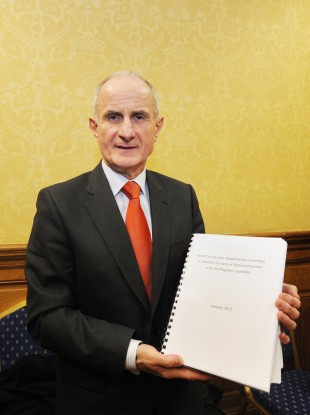
Report of the Inter-Departmental Committee to establish the facts of State involvement with the Magdalen Laundries
Introduction by the Independent Chair Senator Martin McAleese
1. There is no single or simple story of the Magdalen Laundries.
2. This Report has established that approximately 10,000 women are known to have entered a Magdalen Laundry from the foundation of the State in 1922 until the closure of the last Laundry in 1996. Of the cases in which routes of entry are known, 26.5% were referrals made or facilitated by the State.
3. Many of the women who met with the Committee - and particularly those who entered the Magdalen Laundries as young girls - experienced the Laundries as lonely and frightening places. For too long, they have been and have felt forgotten. Indeed for many of them, an inability to share their story in the years after their time in a Magdalen Laundry has only added to the confusion and pain they feel about that period in their lives.
4. The mandate of the Inter-Departmental Committee was to establish the facts of State involvement with the Magdalen Laundries. These facts are set out in this Report as the Committee has found them. During this fact-finding process, the Committee also gained a deeper and broader understanding of the Magdalen Laundries and the context in which they operated. The Committee has, in this Report, drawn on all available information and sought to record as comprehensive a picture as possible of the operation of the Magdalen Laundries.
5. In doing so, the Committee was conscious that the operation of the Magdalen Laundries since the foundation of the State has, prior to this process, not been fully understood, as many State records were neither readily available nor easily accessible and the records of the Religious Congregations were not
available for inspection or analysis.
6. It is understandable that – fuelled by this absence of information – stories grew to fill these gaps. Indeed, the answers to questions as basic as how to establish the facts of State involvement with the Magdalen Laundries many women and girls passed through the Magdalen Laundries or how long they remained there have, until the release of this Report, not been known. Otherwise, the chronicle of the Magdalen Laundries was for many years characterised primarily by secrecy, silence and shame.
7. The picture that the Committee has been able to put together tells the following story. The women who were admitted to and worked in the Magdalen Laundries, whether for short or long periods of time since the foundation of the State, have for too long felt the social stigma of what was sometimes cruelly called the ‘fallen woman’. This is a wholly inaccurate characterisation, hurtful to them and their families, that is not borne out by the facts. The Committee found no evidence to support the perception that unmarried girls had babies there, or that many of the women of the Magdalen Laundries since 1922 were prostitutes. The reality is much more complex. As set out in detail in this Report, the women who entered the Magdalen Laundries were from many backgrounds and the circumstances which led to their admission were varied:
- Some women were referred to the Magdalen Laundries by Courts on remand, on probation or otherwise on foot of criminal convictions ranging from vagrancy and larceny to manslaughter and murder.
- Some were children, released on licence from Industrial or Reformatory Schools to the Magdalen Laundries before they reached 16 years of age.
- Some were former Industrial School children referred onwards either directly from these Schools or during the period of their post-discharge supervision.
- Some were young girls who had been boarded-out and were rejected by their foster parents when maintenance payments from the authorities ceased.
- Some were young women over 16 years of age, who had been orphaned or who were in abusive or neglectful homes (in many of these cases, their younger siblings would have been committed to Industrial Schools).
- Some were women with either mental or physical disabilities which rendered them unable to live independently, at a time when supported living facilities did not exist. Some had psychiatric illnesses and were referred from psychiatric hospitals.
- Some were referred by social services at a time when appropriate accommodation for teenagers was not available.
- Some were simply poor and homeless and either voluntarily sought shelter in or were referred to the Magdalen Laundries by County Homes or, later, by social services.
- Many girls and women were placed in the Magdalen Laundries by their own families, for reasons that we may never know or fully understand, but which included the socio-moral attitudes of the time as well as familial abuse.
These and a myriad other stories make up the background of the women who spent some period of time in a Magdalen Laundry between 1922 and the closure of the last such institution in the State in 1996.
8. The girls and women referred to the Magdalen Laundries by officials in the criminal justice system, social services, or even from psychiatric hospitals and County Homes would have been made aware why they were there and – in the case of court referrals - how long they were required to stay.
9. However, this would not have been the experience of the young girls referred to the Magdalen Laundries from industrial schools or by non-state agents, including girls referred by their own families. None of us can begin to imagine the confusion and fear experienced by these young girls, in many cases little more than children, on entering the Laundries - not knowing why they were there, feeling abandoned, wondering whether they had done something wrong, and not knowing when - if ever - they would get out and see their families again. It must have been particularly distressing for those girls who may have been the victims of abuse in the family, wondering why they were the ones who were excluded or penalised by being consigned to an institution.
10. To add to this confusion, most found themselves quite alone in what was, by today’s standards, a harsh and physically demanding work environment. The psychological impact on these girls was undoubtedly traumatic and lasting. In meeting some of them, and listening to their stories, the Committee was impressed by their quiet determination to find answers to the many questions concerning their lives both before and after entering a Magdalen Laundry.
11. The Committee is aware that there are other women who find it difficult or even impossible to share their stories of the Magdalen Laundries. Some may not have even told their husbands or children of that period in their lives, but instead are carrying those experiences silently in their hearts. Many of these women will choose never to reveal their “secret”, because of the impact they fear it might have on their lives. It is the absolute right of every woman to make this choice for herself and the Committee wants to reassure these women that their right to privacy is utterly respected throughout this Report. The Committee nonetheless hopes that the contents of the Report, insofar as it is able to present the facts and set the record straight, may in some small way be of help to them.
12. It is also true to say that many of the Sisters of the four Religious Congregations which operated these institutions – whether they worked in them or not – have experienced a profound hurt in recent years as the debate on the Magdalen Laundries gained increasing public prominence. Their position is that they responded in practical ways as best they could, in keeping with the charism of their Congregations, to the fraught situations of the sometimes marginalised girls and women sent to them, by providing them with shelter, board and work. They state clearly that they did not recruit women for these institutions. The Committee found no evidence to contradict this position.
13. In addition to their legal obligation not to disclose the personal data they hold, the Sisters also continue to feel a strong moral responsibility to protect the privacy of the women who passed through their doors. The Committee believes that it is for this reason, and not for secrecy or self-interest, that their archives, which were so willingly opened to this Committee, have not been opened more broadly to researchers or the general public. The Sisters have, however, consistently made available all the personal records they hold directly to the women concerned or, in the case of deceased women, to their next of kin, when requested, and have confirmed to the Committee their intention to continue to do so in the future.
14. The Congregations informed the Committee that this commitment to ensure anonymity and to protect privacy was also the reason why, in some but not all of the Magdalen Laundries, women were given a “House” or “Class” name which was used instead of their birth name. Many of the women who met the Committee, however, found this practice deeply upsetting and at the time, felt as though their identity was being erased. The Congregations have expressed to the Committee their regret that women who were in their care hold this or other painful memories.
15. This Report examines five main areas in which there was possible State involvement with the Magdalen Laundries. In each case, the Report sets out both the policy and practice as the Committee has found them, as well as the legislative basis for State action (where applicable). The five main areas are:
- Routes by which girls and women entered the Laundries;
- State inspections of the Laundries;
- State funding of and financial assistance to the Laundries;
- Routes by which girls and women left the Laundries;
- Death registration, burials and exhumations.
In each of these areas, the Committee found evidence of direct State involvement.
16. The Committee’s findings regarding each of these areas are outlined in the Executive Summary and detailed in the Report, as are a number of other miscellaneous areas of State involvement including issues relating to electoral registration, insurability of employment, provision in relation to rationing during the Emergency, and industrial surveys under the Census of Distribution and Services.
17. In the course of the Committee’s work, material was also uncovered that is central to answering many frequently arising questions concerning the Magdalen Laundries. The Committee is aware that some of this material is, strictly speaking, outside its core remit. However, while mindful of its Terms of Reference, the Committee considered these issues to be consequential on its principal findings and decided, in the public interest, to include these additional findings in a separate section of the Report (Part IV), with relevant statistics contained in the body of the Report at Part II.
18. The material in these sections of the Report and in particular the statistical analysis may also contribute to future historical study and research, without in any way breaching the trust or privacy of the women referred to. It is also likely to be of considerable interest to the women, their families and the wider public. These findings, summarised below, may challenge some common perceptions.
Background of the women who entered the Magdalen Laundries:
Without identifying any person, the profiles of the women who entered the Magdalen Laundries (including those who were not referred by the State or State agents) are set out in some detail in the Report. These profiles include details on the geographical origin of these women (those who came from rural or urban backgrounds); parental background (whether one or both parents were deceased) and those who had been previously institutionalised. There is a perception that the vast majority of women who entered the Laundries spent the rest of their lives there - in fact, as set out in this Report, the majority (61%) spent less than one year there. This and other information is contained in these profiles, including information on the average age on entry, average duration of stay, as well as the minority of women who remained in the Magdalen Laundries until their deaths.
Conditions in the Laundries:
The Report also addresses the question of the conditions experienced by and the treatment of women in the Laundries, including the questions of sexual abuse, physical abuse and verbal or psychological abuse. This is a particularly sensitive and difficult issue to deal with, made more difficult by the very small sample of women available and in a position to share their experiences with the Committee.
The Committee does not make findings on this issue. Rather, the Report records the stories shared with the Committee by these women, as well as the medical reports and recollections of General Medical Practitioners who served the Laundries in more recent times and others who were closely associated with the operation of the Laundries.
No woman referred to a Magdalen Laundry on foot of a criminal conviction made contact with the Committee. Instead, the majority of the small number of women who engaged with the Committee had been admitted to the Laundries either by a non-state route of referral or, most common of all, following time in an Industrial School. Many of these women drew a clear distinction between their treatment in Industrial Schools and their experience in the Magdalen Laundries.
They made no allegations of sexual abuse against any of the Sisters, but one allegation was made against another woman. The vast majority also told the Committee that the ill-treatment, physical punishment and abuse that was prevalent in the Industrial School system was not something they experienced in the Magdalen Laundries. However, the majority of women described the atmosphere in the Laundries as cold, with a rigid and uncompromising regime of physically demanding work and prayer, with many instances of verbal censure, scoldings or even humiliating put-downs. In that regard, some women and others associated with the operation of the Magdalen Laundries told the Committee that the atmosphere “softened” in more recent decades and particularly after the second
Vatican Council (1962-1965).
Some of the women the Committee met stated clearly that the Laundries were their only refuge in times of great personal difficulty. Others spoke of their real sense of being exploited. But the large majority of women who engaged with the Committee and especially those who had previously been in Industrial Schools spoke of the deep hurt they felt due to their loss of freedom, the fact that they were not informed why they were there, lack of information on when they would be allowed to leave, and denial of contact with the outside world, particularly family and friends.
Financial viability of the Magdalen Laundries:
The issue of the financial viability of the Magdalen Laundries is also addressed. There have been suggestions that the Laundries were highly profitable institutions. The evidence identified by the Committee and analysis of the financial records of the Magdalen Laundries during various periods of their operation indicate that this was not the case. The Laundries operated for the most part on a subsistence or close to break-even basis rather than on a commercial or highly profitable basis. The financial accounts tend to support the fact that, what came to be known as the Magdalen Laundries, were historically established as refuges, homes or asylums for marginalised women and girls. The subsequent establishment of the Laundries was for the purposes of financially supporting and maintaining them.
19. The members of the Committee approached their work in a committed and professional manner and both they and their Departmental colleagues are due thanks and credit for their considerable efforts. Searching for official records and materials relating to the Magdalen Laundries presented many problems.
Information relevant to the Committee’s work was contained in a very wide variety of records across many bodies, agencies and individuals. Much of the material held by the State was not archived or catalogued. In this age of instant online searches, it is easy to forget that access to digitised historic material is the exception rather than the rule. Accordingly and to complete their work, members of the Committee and their Departmental colleagues hand-searched paper archives in their Departments, National Archives, the National Library; explored boxes of uncatalogued materials and indeed physically searched Departmental basements in an attempt to discover any misplaced files and folders. Similar detailed searches were conducted in State agencies and bodies. Given the significant efforts made to gather these scattered files and records, the Committee decided to recommend that copies of all official records identified should be preserved as a distinct archive in the Department of An Taoiseach.
20. The Committee wishes to acknowledge with gratitude the tremendous contribution to its work and to the preparation and drafting of this Report by Nuala Ní Mhuircheartaigh. Her work ethic and commitment were outstanding.
21. A large variety of private archives were voluntarily made available to the Committee and it is important to acknowledge that without them the work of the Committee would have proved very difficult, if not impossible, to accomplish. In particular and of critical importance to the progress of the Committee’s work is the fact that the four Religious Congregations – the Sisters of the Good Shepherd, the Sisters of Our Lady of Charity, the Religious Sisters of Charity, and the Sisters of Mercy – voluntarily opened all their records to inspection and analysis and made themselves available at all times to provide the Committee with the fullest information they could.
22. In conducting its work, the Committee also relied heavily on the voluntary cooperation and goodwill of many individuals and organisations. The help and support offered by the Central Statistics Office was invaluable to the process and the assistance offered by private archives, in particular by the Dublin
Diocesan Archive and organisations such as the Irish Society for the Prevention of Cruelty to Children, was significant.
23. A number of former residents of the Magdalen Laundries shared their experiences with the Committee as members of representative and advocacy groups (53), while others did so directly in their own right as individuals (7). Some of these women shared their stories on a strictly confidential basis. A valuable contribution was also made by women (58) who are currently resident in nursing homes under the care of the Religious Congregations.
24. The stories shared with the Committee by these women provided invaluable insights into the operation of the Laundries and helped the Committee greatly in preparing this Report. The majority of them expressed the fact that they had, for many years, felt forgotten and not believed. This took great courage and the Committee acknowledges its indebtedness to them for their contributions and for the dignified way in which they were presented.
25. The representative groups Irish Women’s Survivors Network UK and Magdalen Survivors Together and the advocacy group Justice for Magdalenes also made a significant contribution to the work of the Committee. From the outset, they cooperated fully with the Committee, sharing their research, analysis and views.
26. The work of the Committee commenced in July 2011 and took eighteen months in total to complete. The initial preparatory work was carried out within six months, while the substantive research, investigation and drafting of the Final Report was concluded in a further twelve months. No member of the Committee received a salary or stipend in relation to its work. The only direct costs arose from travelling expenses and room hire for meetings. These costs amounted to € 11,146.06.
27. The Committee has produced a substantive and detailed Report, identifying hitherto unknown facts of State involvement with the Magdalen Laundries and clarifying ancillary matters more broadly in the public interest. It is possible that some more detail could be added with more time, but the Committee is of the view that such additional time or probing would, at best, add only marginally to the facts already clearly and unambiguously established in this Report.
28. In light of the Committee’s mandate, there is an understandable focus in this Report on the cases of State referral to the Magdalen Laundries, in particular Criminal Justice System and Industrial and Reformatory Schools referrals. The Committee urges a strong word of caution against generalisations in this respect. An unforgivable injustice would be done to the facts and complexity of the story – and more importantly to the women concerned - if public discourse was to simply replace one label with another, by shifting the terminology from that of the ‘fallen’ to the ‘criminal’ woman. Respect for the complexity and sensitivity of this story means that any new caricatures of the women who spent time in Magdalen Laundries, or indeed of the Religious Congregations who operated them, must be avoided.
29. The Committee found significant State involvement with the Magdalen Laundries. Its findings in many cases may also encourage a review of some perceptions about these institutions and the women who were admitted to and worked in them. The Committee hopes that the facts established for the first time by its work, and set out in this Report, will contribute to a more complete, accurate and rounded understanding of these issues. Most important of all, the Committee hopes that this Report will be a real step in bringing healing and peace of mind to all concerned, most especially the women whose lived experience of the Magdalen Laundries had a profound and enduring negative effect on their lives.
Senator Martin McAleese
Independent Chair
Monday, 28 January 2013
"Catholic" politicians
Does Enda Kenny have any sense of himself as a member of the Catholic Church? Does any "Catholic" politician? I take Kenny as an example based on this recent behaviour. After all the years of Vatican II, after endless references to "the People of God" and being told that the Church was more than the bishops I see no evidence that the message has got through. If anything, there was a far greater sense in the past of lay people being part of the Church.
For example, read this recent news article about the new coadjutor Archbishop of Armagh:
THE Taoiseach Enda Kenny today welcomed the announcement of the appointment of Monsignor Eamon Martin as Coadjutor Archbishop of Armagh and successor to Catholic primate Cardinal Sean Brady when he retires.
"It's a matter entirely for the Catholic Church but I think the fact that the new appointment has some experience of the area of children protection and security obviously is very welcome," he said [always has to get the dig in.]
The Taoiseach said that he had "very good relations with the Catholic Church", adding that he was due to meet Cardinal Brady this afternoon to talk about what he described as "a very long agenda as part of the structure dialogue that I have with the churches. I'm very happy to engage with the [Catholic] church. We have lots to talk about".
Does this sound like someone who is actually a member of the Catholic Church that he's talking about?
And how delusional is he if he thinks he has "good relations" with the Church? Perhaps his sense of separatedness is in preparation for when he introduces direct abortion legislation and can no longer receive Holy Communion.
For example, read this recent news article about the new coadjutor Archbishop of Armagh:
THE Taoiseach Enda Kenny today welcomed the announcement of the appointment of Monsignor Eamon Martin as Coadjutor Archbishop of Armagh and successor to Catholic primate Cardinal Sean Brady when he retires.
"It's a matter entirely for the Catholic Church but I think the fact that the new appointment has some experience of the area of children protection and security obviously is very welcome," he said [always has to get the dig in.]
The Taoiseach said that he had "very good relations with the Catholic Church", adding that he was due to meet Cardinal Brady this afternoon to talk about what he described as "a very long agenda as part of the structure dialogue that I have with the churches. I'm very happy to engage with the [Catholic] church. We have lots to talk about".
Does this sound like someone who is actually a member of the Catholic Church that he's talking about?
And how delusional is he if he thinks he has "good relations" with the Church? Perhaps his sense of separatedness is in preparation for when he introduces direct abortion legislation and can no longer receive Holy Communion.
Friday, 25 January 2013
The Fine Gael Pro-life 15
Which TDs in Fine Gael might be considered pro-life and might be supported to vote against abortion legislation?
In Dublin, Lucinda Creighton, Peter Mathews, Derek Keating and Terence Flanagan;
In Leinster, James Bannon, John-Paul Phelan and Billy Timmins;
In Connaught-Ulster, John O'Mahony, Michelle Mulherin, Brian Walsh and Tony McLoughlin;
In Munster, Pat Breen, Tom Hayes, Michael Creed, Patrick O'Donovan and John Deasy.
It is vital that these TDs be supported, not threatened, not lectured, not put under inappropriate pressure, but supported, encouraged, prayed for. If you can talk to them, do so, thanking them for their support and if you can engage them on the issue of abortion and suicide. This is the key area as this is the only area that involves direct abortion rather than medical treatment. Balance the question of slippery slope regulation (anyone can pretend to be suicidal and experience from UK is clear that women will lie and doctors will lie - doctors who support direct abortion will generally have no qualms about adjusting forms to support women who want abortion) with the simple moral position that it is wrong to destroy even one innocent life when it is unnecessary. Keep calm and respectful at all times, even if you feel angry.
On the question of Enda Kenny, no one in the pro-life movement believes or trusts him. But remember to Fine Gaelers he is the chief and a lot of them trust him, trust his judgment, his former pro-life credentials, basic decency etc. (Ed. did they never hear his ridiculous attack on the Pope and his closure of the embassy?). So best not to go in swinging. Gently suggest his is mistaken, perhaps confused on the issue.
But do end with a clear appeal, to influence legislation before it is too late, and if the legislation turns out (as likely) to involve direct abortion, appeal to their conscience, that this is the moment of truth for them as individuals, bigger than politics or party. This is their St Thomas More moment.
In Dublin, Lucinda Creighton, Peter Mathews, Derek Keating and Terence Flanagan;
In Leinster, James Bannon, John-Paul Phelan and Billy Timmins;
In Connaught-Ulster, John O'Mahony, Michelle Mulherin, Brian Walsh and Tony McLoughlin;
In Munster, Pat Breen, Tom Hayes, Michael Creed, Patrick O'Donovan and John Deasy.
It is vital that these TDs be supported, not threatened, not lectured, not put under inappropriate pressure, but supported, encouraged, prayed for. If you can talk to them, do so, thanking them for their support and if you can engage them on the issue of abortion and suicide. This is the key area as this is the only area that involves direct abortion rather than medical treatment. Balance the question of slippery slope regulation (anyone can pretend to be suicidal and experience from UK is clear that women will lie and doctors will lie - doctors who support direct abortion will generally have no qualms about adjusting forms to support women who want abortion) with the simple moral position that it is wrong to destroy even one innocent life when it is unnecessary. Keep calm and respectful at all times, even if you feel angry.
On the question of Enda Kenny, no one in the pro-life movement believes or trusts him. But remember to Fine Gaelers he is the chief and a lot of them trust him, trust his judgment, his former pro-life credentials, basic decency etc. (Ed. did they never hear his ridiculous attack on the Pope and his closure of the embassy?). So best not to go in swinging. Gently suggest his is mistaken, perhaps confused on the issue.
But do end with a clear appeal, to influence legislation before it is too late, and if the legislation turns out (as likely) to involve direct abortion, appeal to their conscience, that this is the moment of truth for them as individuals, bigger than politics or party. This is their St Thomas More moment.
Monday, 21 January 2013
Kenny needs to catch Agrippa
I was watching Herod Kenny on The Week in Politics this evening. Not once did he answer a question asked, or even come close to answering it. The worst was when asked about abortion and, with a decided smirk, he told the horror of receiving letters and emails saying he was worse than Herod.
Personally I'd see him as more of a Pontius Pilate, but I'm happy to stick with Herod and Ivana can be Mamie Cadden. Kevin Myers threw in a Herod reference back in October so it's hardly new.
The interviewer, as usual with RTE, wasn't great. Better than some, he did interrupt a few times when he tried to go into the single transferable Enda speech of stabilising the economy and creating jobs, but never stuck to the question asked with the Robin Day/Paxman rigour required of Kenny.
Three times he asked him what deterrent would be put in place if the 1861 Offences Against the Persons Act were to be repealed. Each time Kenny began the waffle of referring to the expert committee, the X Case, the ABC case, the protocols, the processes. "Yes, Taoiseach, that's all very well but will there be any criminal sanction?"
Three times asked, three times avoided. I think we know the answer.
If you've a bit of spare time toddle over to Wikipedia and visit the page on Abortion in the Republic of Ireland. If you're signed up to edit have a look at improving the page. It's written from a pro-choice slant. I spent a few moments amending the references to the 12th and 25th Amendments to clarify that more than removing the reference to suicide was involved and that they were defeated following opposition from both pro-life and pro-choice supporters. I hadn't time to do more. But this is another field where the battle for hearts and minds takes place. Róisín Bán!
Text of the 1861 Offences Against the Persons Act:
58. Every Woman, being with Child, who, with Intent to procure her own Miscarriage, shall unlawfully administer to herself any Poison or other noxious Thing, or shall unlawfully use any Instrument or other Means whatsoever with the like Intent, and whosoever, with Intent to procure the Miscarriage of any Woman, whether she be or be not with Child, shall unlawfully administer to her or cause to be taken by her any Poison or other noxious Thing, or shall unlawfully use any Instrument or other Means whatsoever with the like Intent, shall be guilty of [an offence], and being convicted thereof shall be liable, ..., to [imprisonment] for Life ...
59. Whosoever shall unlawfully supply or procure any Poison or other noxious Thing, or any Instrument or Thing whatsoever, knowing that the same is intended to be unlawfully used or employed with Intent to procure the Miscarriage of any Woman, whether she be or be not with Child, shall be guilty of [an offence], and being convicted thereof shall be liable, ..., to [imprisonment for a term not exceeding five years].
Personally I'd see him as more of a Pontius Pilate, but I'm happy to stick with Herod and Ivana can be Mamie Cadden. Kevin Myers threw in a Herod reference back in October so it's hardly new.
The interviewer, as usual with RTE, wasn't great. Better than some, he did interrupt a few times when he tried to go into the single transferable Enda speech of stabilising the economy and creating jobs, but never stuck to the question asked with the Robin Day/Paxman rigour required of Kenny.
Three times he asked him what deterrent would be put in place if the 1861 Offences Against the Persons Act were to be repealed. Each time Kenny began the waffle of referring to the expert committee, the X Case, the ABC case, the protocols, the processes. "Yes, Taoiseach, that's all very well but will there be any criminal sanction?"
Three times asked, three times avoided. I think we know the answer.
If you've a bit of spare time toddle over to Wikipedia and visit the page on Abortion in the Republic of Ireland. If you're signed up to edit have a look at improving the page. It's written from a pro-choice slant. I spent a few moments amending the references to the 12th and 25th Amendments to clarify that more than removing the reference to suicide was involved and that they were defeated following opposition from both pro-life and pro-choice supporters. I hadn't time to do more. But this is another field where the battle for hearts and minds takes place. Róisín Bán!
Text of the 1861 Offences Against the Persons Act:
58. Every Woman, being with Child, who, with Intent to procure her own Miscarriage, shall unlawfully administer to herself any Poison or other noxious Thing, or shall unlawfully use any Instrument or other Means whatsoever with the like Intent, and whosoever, with Intent to procure the Miscarriage of any Woman, whether she be or be not with Child, shall unlawfully administer to her or cause to be taken by her any Poison or other noxious Thing, or shall unlawfully use any Instrument or other Means whatsoever with the like Intent, shall be guilty of [an offence], and being convicted thereof shall be liable, ..., to [imprisonment] for Life ...
59. Whosoever shall unlawfully supply or procure any Poison or other noxious Thing, or any Instrument or Thing whatsoever, knowing that the same is intended to be unlawfully used or employed with Intent to procure the Miscarriage of any Woman, whether she be or be not with Child, shall be guilty of [an offence], and being convicted thereof shall be liable, ..., to [imprisonment for a term not exceeding five years].
Monday, 14 January 2013
Enda Kenny's RTE interview
Who do you think you are kidding Mr. Kenny?
If you think we're on the run,
We are the boys who will stop your little game.
We are the boys who will make you think again.
'Cus who do you think you are kidding Mr. Kenny?
If you think old Ireland's done?
Catholicus goes off to town
And starts his daily slog.
But he comes home each evening
And he's ready with his blog.
So who do you think you are kidding Mr. Kenny?
If you think old Ireland's done.
Ireland's Home Guard are calling you to gather next Saturday, 19th January, 4.30pm at Merrion Square, Dublin. We have to defend our country against the enemy.
Subscribe to:
Posts (Atom)